Pages

Showing posts with label Film. Show all posts

Tuesday, 31 March 2020

MISTRESS AMERICA - FILM - NETFLIX


Featuring actors and directors that had a hand in Marriage Story, Ladybird and Mozart in the Jungle, this movie fits well into this little cultural slot of urbane, educated, restless, slightly unhappy creative people in modern America.


“I'm pretty sure college is supposed to be more fun than I'm having,” says central character Tracy, played by the luminous Lola Kirke from Mozart in the Jungle. This is Tracy’s central experience; she has come to New York to go to university and expected it to be ground breaking and magical. Instead it is isolating, scary and full of pretentiousness.

Everything changes when she meets Brooke (played by Little Women director Greta Gerwig), who is about to become her step-sister. Brooke is older, ambitious, self-invented, untethered by convention and routine. She says things like; “he’s one of those people that I hate, except that I am in love with him.” Tracy and Brooke’s conversations are full of the following kind of exchanges….

Brooke: “I’m an auto-didact, do you know what that means?”
Tracy: “Yes”.
Brooke: “That word is one of the things I self-taught myself.”

At times the quirkiness overwhelms the cleverness, yet the wit, sharpness and sheer effortless brilliance of the dialogue are undeniable.

Tracy is the central character and a kind of narrator, but it is Brooke (Greta Gerwig) who is by turns horrible, hilarious and profound, and who gets all the best lines. 

Brooke: "I think I'm sick and I don't know if my ailment has a name. It's just me sitting and staring at the Internet or the television, interspersed with trying not to do that, then lying about what I've been doing. And I will get so excited about something that the excitement overwhelms me. And I can't sleep or do anything and I just am in love with everything, but can't figure out how to make myself work in the world."


It also features the weird, haunting, beautiful Souvenir, a song by Orchestral Manoeuvres in the Dark, resurrected from the depths of the Eighties and given new life as a backdrop to a tale of Gen Z kids from the teens. Somehow, it fits perfectly.


In these days when the streets of New York are largely empty, it is moving and nostalgic to see the city full of people, buzzing, the bars heaving.

Despite the occasional lapse into hipster excess, this is an unexpected, unacknowledged delight. A sweet slice of escapism and romance, for those in need of it.

Friday, 19 December 2014

ST. VINCENT. FILM.

If you want to know what Bill Murray's character - Vin - is like in this film, think Jack Nicholson in As Good as it Gets, or Clint Eastwood in Gran Torino. Or in fact any one of a whole host of irascible, curmudgeonly, alcoholic, bad-tempered old-guys that turn out to be big softies in the end, in scores of films in the past forty years.

There is really nothing new in this movie. Just as Vincent is a variation on the pattern of lovable codger, so we have a varied but predictable cast of odd-balls. There is the obligatory scrawny but smart little kid living next door who Vincent teaches to defend himself, his vulnerable, stressed mother who entrusts her son, Oliver, to Vincent's care after school, and Daga, a pregnant Russian prostitute, again the obligatory hooker-with-a-heart-of-gold.

Even Chris O'Dowd turns up here as a Catholic brother who teaches the children in the local school about saints. Of course O'Dowd is as far from the stern Christian brother of Angela's Ashes as you could get, his is Catholicism lite, he curses and is inclusive of all faiths and none, and his vision of sainthood is a little wider than the Vatican's.

The movie follows a predictable pattern, and almost never surprises. Even the ending, which is obviously supposed to be some kind of climax to which the previous hour and a half has been building, can be seen from an hour away, and is played for every piece of sentimentality that can be wrung out of it.


At its best St Vincent is pleasant and mildly entertaining, though there are few actual laughs in a movie that is purporting to be a comedy. At its worst it is too sugar-sweet and corny and cliched to take seriously, a missed opportunity with a cast that could have done so much more. 

Saturday, 8 November 2014

INTERSTELLAR. FILM.

Interstellar is, I think the technical term is, bonkers.

That doesn't mean that it isn't curious and fascinating and thought-provoking in parts, but the story completely collapses under the enormous weight of the grand ideas and speculative science-fiction that it attempts to incorporate.

Matthew McConaghey is Cooper, an ex-NASA pilot who lives with his family on a future Earth that is slowly dying. Crops are failing, the environment is slowly turning against human beings.

He and his daughter, Murphy (yes, that is her first name, after Murphy's Law) come across the remnants of the old NASA, run by Professor Brand, (Michael Caine).

The Professor has a plan to save mankind, and enlists Cooper to pilot a mission to the stars. Brand's daughter, played by Anne Hathaway, and two other scientists, go with him.

There is a subplot about Murphy being contacted by ghosts, or extra-terrestrials, and messages left for her in the movement of books in her bedroom. This is returned to later on, though never at any stage becomes anything that makes sense, and in fact only adds to the nonsensical feeling of the whole.

Matt Damon turns up for a while, in a pointless cameo, just to add to the intrigue. There is a wormhole, and a black hole, and talk of event horizons and gravity and time travel.

The film soon becomes a bizarre melange of adventure story, disaster epic and family drama, with a large dose of sci-fi (heavy on the "fiction", light on the "science") mixed in.

Things get progressively more preposterous as the film goes on. The ending is open for debate, as it isn't completely clear exactly what happens. The film skimps on detail, and tends to skip over any of the inconvenient elements that are simply too complex or ill-thought-out to explain.

But the Black Hole scenes towards the end are mostly ludicrous, and the half-hearted attempt at explaining what and how it happens is just that, half-hearted, there is little real sense in the way things wrap up, and almost no attempt at being consistent or meaningful. The part played by a watch in the denouement is particularly silly.

There is also a cringe-worthy theme running through the film, that Love is the only thing that can defeat time, gravity and whatever else gets in its way. It is hard not to laugh out loud at parts of this ridiculous script.


Still, it does have cool robots. They are probably the only successful innovation in the movie, the only thing that hasn't been seen before that actually impresses. At first glance they just look like giant metal Kit-Kats, unwieldy and clumsy, but are in fact flexible and smart, heroic and even tell jokes, and are possibly the only light relief in a movie that takes itself, and its ludicrous plot, a little too seriously.  

Tuesday, 4 November 2014

NIGHTCRAWLER. FILM.

Jake Gyllenhaal is Nightcrawler. He is the nightcrawler of the title, but he is also Nightcrawler, the film. He utterly dominates the movie, he is in every scene, the whole enterprise revolves around him and his character, Lou Bloom.

It is just as well, then, that he is mesmerizing in this, utterly believable. Lou Bloom is a petty thief with higher aspirations, he thinks nothing of mugging people and robbing bicycles, but he wants more, he wants a job, a purpose, he wants more.


One night while driving around Los Angeles he comes across a car accident, which is being filmed by an independent film crew which then sells the footage on to TV stations for their morning news. These are the nightcrawlers of the title. Lou gets himself a video camera, and starts trawling the streets of LA at night, searching for something to film and sell.

Lou's utter lack of compassion and empathy, it turns out, makes him very good at his new profession. He thinks nothing of getting to an accident scene before the emergency services, and then dragging a dead body into a more convenient location so that it is easier to film and gives a better shot.

He begins selling his videos to Renee Russo's character, Nina, who works as news director in a TV news station that is struggling with ratings. She sees in Lou a kind of kindred spirit, someone who is indifferent to questions of morality and ethics, someone who, like her, is only interested in appealing to the baser elements of human nature.

At first we are at least partly pulling for Lou. He appears enthusiastic and only wants to better himself. He has ambition and a project, and just wants a chance. But his sociopathic tendencies emerge as the film goes on, and this sympathy slowly wanes.

One weakness the movie has is that it has a Message. And this Message slowly becomes apparent through the characters of Lou and Nina. It is clear that it is at least partly a social commentary on sensationalist media, on TV news that is happy to exploit human misery for its own ends.

At one stage Nina asks her assistant if they can show a particularly gruesome piece of footage of a murder. The assistant asks "You mean legally?" Nina replies, sarcastically, contemptuously, "No, morally. Of course I mean legally." The implication is that morality plays no part in their decisions, the bottom line is whether it will shock, whether it will attract viewers. The bodies they film and show are pieces of meat, the wrecked lives are an irrelevance in their quest to draw in as many viewers as possible.

And this Message is a little heavy-handed, at times. There are parts of the movie that make it seem like the characters are simply vehicles for this message, those, like Lou and Nina, who put ratings above all else, and other minor characters, such as Rick, Lou's employee, and the voice of reason, who raise objections to his ever-more extreme tactics.

Yet for all that, it is a powerful, compelling piece of film-making. The visual power of Los Angeles at night is a key element in the feeling of the movie, and the whole thing is atmospheric and tense, with a hypnotic central performance from Jake Gyllenhaal.  


Tuesday, 28 October 2014

THIS IS WHERE I LEAVE YOU. FILM.

The first thing to be said about this film is that it has a fantastic cast.

Jane Fonda plays the matriarch of the Altman family, the centre of the story. The rest of the cast is a list of many of the best American TV actors of their generation.


Jason Bateman (from Arrested Development) plays the middle brother in a family of four siblings whose father has just died, Tina Fey (30 Rock) is his sister, while Corey Stoller (House of Cards) and Adam Driver (Girls) are the other brothers.

Then there is Rose Byrne (Damages), Timothy Olyphant (Deadwood, Justify), Kathryn Hahn (Suburgatory), Abigail Spencer (Rectify), Connie Britton (Nashville), Ben Schwartz (Parks and Rec) who play a variety of characters connected in some way to the central Altman family.

The litany of recognisable faces is almost distracting, and in some ways the quality of the cast overwhelms what is a relatively slight film.

Nevertheless, This is where I leave you is enjoyable. It centres around the seven days after the death of Mort Altman, where the family sit Shiva, the traditional Jewish way of marking the dead where the relatives of the deceased do not leave the house and receive visitors for a week.

The interplay between the siblings is the strongest part of the story. There are jealousies, fights, betrayals, secrets revealed, nostalgia, much of which will be recognised by anyone from a family of more than one.

However, the movie constantly struggles against a tide of sentimentality that threatens to overwhelm it. Conflicts are resolved a little too easily, the film assumes everyone has only good intentions and people's flaws are mostly just used as vehicles for comedy. The score, too, lays on the shmaltz, signposting when you are supposed to be moved by a particular scene.  

Yet for all that, the film just about manages to avoid over sugaring the pill. The performances carry the story, Bateman is subtle and conflicted, Tina Fey is funny and wry and genuine, Jane Fonda is just this side of bonkers, and the movie retains a charm and an energy that is hard to resist.


A MOST WANTED MAN, SIN CITY - A DAME TO KILL FOR. FILMS BOTH.

A MOST WANTED MAN

A Most Wanted Man is Philip Seymour Hoffman's final film, and really doesn't have much more to recommend it than that.

Based on a John Le Carré novel, PSH's character is Gunther Bachmann, a German spy who runs a small, covert team in the northern city of Hamburg that are attempting to track the funding of Muslim extremism in Germany.


Isa Karpov, a Chechen tortured by the Russians, turns up in the city, with a desire to make up for his Russian father's crimes, and a hope to be allowed to stay in Germany. He is helped by Rachel McAdams, who plays an idealistic lawyer Annabel Richter, involved in a human rights organisation.

And then a lot of nothing happens. There are long, slow shots of PSH drinking or smoking, quick meetings on ferry boats, the occasional conversation that attempts to move the thin plot along, and all the time you are waiting for something like a story to develop. And it never really does.

The action meanders over and back between meeting rooms, safe houses and the street. The other German security agencies are simplistically portrayed as brutal and dumb, and we are somehow supposed to see Gunther and his team as sympathetic characters, the best of a bad lot.

Yet the whole thing is so limp and lacking in insight, energy or any real explanation. We only get to see the surface of things and characters, none of their true motivations are revealed, in fact there are no real revelations of any significance at all. There is almost no drama, and for a spy film, little real tension. A sad way for a great actor to go out.


SIN CITY

This, the second Sin City movie, follows on from the first film in the series, and is more of the same.

Jessica Alba, Bruce Willis and Mickey Rourke are all back in the same roles, playing their damaged, violent, brooding characters. The movie is based on a graphic novel by Frank Miller, and retains the visual style of the original, the action is semi-animated and semi-live action, giving the whole film a curious, dream-like quality.


Apart from the visuals, though, there is really nothing else to recommend in this film. It is filled with pointless, stupid, stylized violence.  Practically everyone in the film dies or is mutilated. There are lakes of blood, and piles of bodies.

The violence becomes so commonplace that you don't even notice all the death and blood and mutilation.

The various bad guys (and gals) in the story have the usual array of goons protecting their residences, but these muscled cutthroats get murdered in their hundreds by the collected stars of Mickey Rourke, Jessica Alba and Josh Brolin.


It attempts to ape the style of film noir, and achieves this, but there is no subtlety, no light relief, nothing beyond the stylized visuals and the choreographed mayhem.

This second Sin City movie is a triumph of style over substance. Utterly lacking in humour, it takes itself way too seriously.


Friday, 1 August 2014

BOYHOOD. FILM

Richard Linklater is one of the great filmmakers of his generation, and Boyhood might just be his greatest achievement.

The film was shot over a period of twelve years with the same actors playing the same roles. The "boy" of the title is Mason, played by Ellar Coltrane, who is seven when we first meet him and his family, living in Houston, Texas.

Linklater and the cast then shot a small number of scenes every year, building on the story, watching the lives of the characters change, charting the progress of the children in the family.

Lorelei Linklater, the director's daughter, plays Samantha, Mason's sister, and for the first part of the film her story is equally as prominent as the boy's.

As the years go by the characters grow and change. Patricia Arquette and Ethan Hawke play the kids' estranged parents, and as the film goes on we see them get heavier, gain wrinkles, age before our eyes.

The kids' change is the most obvious, of course. Samantha starts off as a chubby, cheeky little girl, and we see her lose her puppy fat, get braces, and become a young woman. Mason slowly grows up too, he loses the soft features of a little boy, his voice breaks and he grows facial hair. And because of the natural passage of time, this is all without makeup or special effects.


There is little conventional plot in the movie, beyond the normal changes and developments of the people's lives. There is a lot of talking, Linklater loves to have his characters just shoot the breeze, talk about life and love and how to live.

What is noticeable is that the parents look back when they talk, and the kids look forward. The parents are nostalgic about their past, the kids excited and anxious about their future.

In the film the passage of time is marked by the changing appearances of the characters, but also by real events happening at the time of filming. We see the Iraq invasion, the first Harry Potter movie, the rise of Lady Gaga, Obama's first election win.

The music too charts our move through the noughties, from Coldplay to Flaming Lips and on to Arcade Fire and the Black Keys.

The film is so replete with ideas and emotions, is so full of layers and themes, that it is probably worth seeing a second and a third time.

Boyhood is an extraordinary, innovative, compelling, at times jaw dropping piece of cinema. A film like no other, and one that will probably never be emulated, in its scope and its examination of youth and growing up.

Friday, 25 July 2014

SUMMER FILMS - CHEF, BEGIN AGAIN, COLD IN JULY.

Chef is a film about the two Fs - Fatherhood and Food.

Eighteen years ago Jon Favreau wrote and directed - along with his buddy Vince Vaughan - his breakout film Swingers. In his latest movie, which he also writes, directs and stars in, he is almost unrecognisable. He is twice the size, for one thing, now with a beard, tattoos, glasses, a receding hairline.

His voice, though, is still distinctive, that almost-whine, the New York vowels still evident even after decades in LA.


He is also surrounded by one of the best casts in a film this year. Scarlett Johannson, Dustin Hoffman, John Leguizamo, Sofia Vergara, Robert Downey Jr, all show up at one time or another, yet it is certainly Favreau's film from start to finish.

He plays the chef of the title, who becomes disillusioned with his job and who realises that he is stuck in a rut. He ends up walking out of his restaurant after a food critic trashes him in an online review.

Favreau's character, Carl, ends up in Miami, with his son and ex-wife, and the chef gets back to basics, opening up a food truck and going back to his Miami Cuban food roots.

Naturally, food has a central role in the movie. The film luxuriates in the joy of food, it is easy to see where Favreaus' extra pounds have come from, he is obviously fond of his nosh, and it shows. Every dish is lovingly prepared and filmed, the camera lingers on the tasty flesh of meat as if it were human bodies writhing in pleasure, pure food-porn. It is impossible to come out after the film and not feel massively hungry.

The fatherhood theme is explored through Favreau's character, Carl Casper who, with his new food truck, manages to reconnect with his ten year old son who he had neglected after his divorce.

It is this son, Perry, who documents the chef's new project, and drums up business for the food truck using social media. In fact, it is really a film of its time, central to the plot are blogs, videos taken on cell phones and posted on-line, twitter wars, Facebook pages and Vine videos.

The relationship between father and son is one of the strongest parts of the story. The film manages to avoid an overdose of sentiment, yet the developing relationship between Carl and Perry, quickly becomes central.

It is Carl's relationships - with his son, with his best friend, played by John Leguizamo, and even with his ex wife - that make this film warm and funny and really impossible to dislike. It is a feel-good film for the decade, a real pleasure.

Similar to Chef in many ways, is Irish director John Carney's new film, Begin Again.

Mark Ruffalo plays washed up music producer, Dan, who - like Favreau's character in Chef - is unfulfilled by his job, divorced, and with a child, this time a teenage daughter, who he has lost touch with.

And like Chef, it is about a new project that takes him back to his roots, and which awakens in him the passion he once felt for his profession. For Dan, his
passion is music.

This new project is Greta, played by Keira Knightley, a singer-songwriter who he discovers in an open mike night. They decide to make an album, though they use the open spaces of the city, New York, as their studio, recording in alleys, on roof-tops, on the street.

And also like Favreau's film, Dan reconnects with his daughter, Violet, though this new venture. She plays guitar on some tracks, father and daughter join together like they have never done before.

Begin Again is a feel-good movie, the tone is light, the music scenes are joyous and celebratory, nothing dark lasts for too long. There is some pain, Greta gets cheated on by her boyfriend, Dan has a drinking problem, but there is never any sense that anything bad is really going to happen.

Keira Knightley really sings on Greta's tracks, which have a certain charm, but which are essentially forgettable. A little like the film itself, likeable but light, pleasing but insubstantial.

Cold in July is a different kettle of fish entirely. It too has a great cast, with Michael C Hall (Dexter), Sam Shepherd and Don Johnson in the central roles.

The film suffers from not really knowing what it is. There are elements of thriller, of horror, of suspense, and also a revenge plot towards the end, as well as family drama and social commentary.

The action takes place in 1989. Michael C Hall plays Richard, who hears noises one night in his family home, and discovers a burglar in his living room. Richard shoots him dead.

This one act, which turns out to have been an accident - Richard's finger slipped on the trigger - itself sets in motion another series of events that are connected to the mob, corrupt policemen and the murders of young vulnerable women.

The film is unpredictable, this is a strong point of the plot, it sets out red herrings and does not conform to expectations. The tension hardly relents from the first scene, Richard is in almost constant danger of one kind or another from beginning to end.

Yet it is also a little too slow paced, you never feel like you are really inside the story, it never feels like the film has really got going. It is at times intriguing, but in the end it resorts to the conventional, and is lacking a heart and could do with more depth.


Monday, 21 July 2014

ANNA KARENINA - NOVEL. ANNA KARENINA - FILM.

Anna Karenina is actually two stories in one.

The first is about the eponymous heroine - the tragic heroine - Anna, who is married to the staid, solid Alexei Karenin. Anna doesn't really realise how small and unfulfilling her life is until she meets Count Vronsky, a dashing officer in the army.


There is a parallel narrative, one that involves Constantine Levin, an aristocrat who lives on his country estate.

Levin is an intense, serious man who lives in the country and dislikes the life of the city. He falls in love with Kitty, who is Anna's sister-in-law, is rejected at first by her, as she is in love with Vronsky. Eventually, Kitty accepts Levin, and they find a way to make their marriage work, despite their differences, and Levin's taciturn nature.

And yet there is so much more in this novel of practically a thousand pages. In fact, there is too much. There are pages worth of descriptions of grouse hunts, or grass cutting, and other parts that deal with the local politics of the 1870s Russia.

Much of it is hard to be interested in from the perspective of the twenty first century. The novel takes too many detours, contains too many digressions, is overweight and sprawling.

In many ways it has almost more historical value than literary. The reader learns a great deal about the lives of the Russian aristocracy, their obsession with all things French - they even speak French among themselves so their servants can't understand - and their lives of idleness and decadence.

Yet, when it comes down to it, it is Anna's story that gives the novel its value. In ways it is almost a feminist novel, we see that when Anna finally leaves her husband for Vronsky, he, Vronsky, is hardly effected by the scandal, but it is Anna who suffers, who is rejected by society, who is prevented from seeing her son.

Anna and Vronsky get what they wanted, and yet learn that this does not necessarily make them happy. Again, it is Anna who feels the brunt of society's disapproval, and it is she who falls into a deep depression, and it is her ending that is especially tragic.

In the other narrative, Levin is a vehicle for many of Tolstoy's own ruminations and doubts, his own questions about his estate and how it should be managed, and for his own philosophical questions, about goodness and God and love. Again, these can get a little repetitive, and Levin's intensity and seriousness make him a character that is hard to love.

All in all this is a flawed book. It is rich and detailed and fascinating in parts, but drags all too often, and could have done with a good editor.

The 2012 film of the novel, is a strange version. The screenplay was written by Tom Stoppard, a playwright, and this is apparent quite quickly.

The urban scenes that are set in St Petersburg and in Moscow contain action that looks like it is taking place on a stage. In many scenes the actors simply walk off stage, through a door and into another set. There is little attempt at realism, it is at times dream-like, at others very mannered and artificial.

For example, in a central scene at the racecourse, Vronsky is taking part in a horse race, watched by the accumulated Moscow aristocracy. Yet the horses are shown to be racing on a stage, and the race-goers are all sitting in a theatre, watching the race and reacting to it as if it were a play.

On the other hand, the scenes that take place in Levin's country estate are much more realistic, there is no playing around with the setting. There is a sense that the film is heightening Tolstoy's own country bias, and commenting on the unnaturalness of aristocratic city life, in contrast with the pure, real existence of the country.

To its credit, the film looks wonderful. The sets, the costumes, the landscapes, are all epic and luscious and grand, in keeping with the lives of the Russian aristocracy.

Many scenes are composed like a paintings, the colours are rich and deep, the stark white of the winter snow contrasting with the darkness of the buildings, and the shapes of the people. The various social gatherings are carefully constructed and choreographed, with all of the luxury of the time.

Yet after reading the novel, the actors chosen to portray the characters don't really fit. Keira Knightley is too slight and slim to portray Anna, who is described as full-figured and imposing. Vronsky too is a much more impressive figure in the novel than Aaron Taylor-Johnson, better known for starring in Kick Ass.

Least convincing of all is Domhnall Gleason as Levin, another character who is described as solid, well-built and stocky. Gleason is exactly the opposite, skinny and slim and not at all physically impressive.

The playing around with the urban scenes is alienating, and makes it difficult to engage with characters than inhabit such a strange, artificial world. The visual pleasures of the film almost make up for this flaw, but not quite. Though at least we don't have to hear about the intricacies of nineteenth century Russian politics!


Monday, 24 February 2014

HER. FILM.

In this film, Joaquin Phoenix's character falls in love with a character played by Scarlett Johannson. Not so unusual, you may imagine, except that Scarlett's character, Samantha, is a computer operating system that has been developed to be sentient.

HER is set in a near-future Los Angeles. It is a relatively benign vision of the future, everyone lives in these large, pristine apartments, there is no sign of
war or plague or disability, the few jobs that we encounter are all aided by technology or are involved with producing that tech.

The only scary thing is that, fashion-wise, the future is apparently inspired by Simon Cowell. The people generally dress as we do, except that - a prospect as terrifying in its own way as a zombie apocalypse - the men all wear high-waisted corduroy trousers, without a belt.

Technology is of course a central part of everyone's lives. We see citizens of this new Los Angeles walking around alone, but constantly talking, they are communicating with their home computers through a tiny device in their ear, listening to emails, having the news of the day read to them.

Theodore Twombly is Phoenix's character, a romantic who is going through a divorce from his childhood sweetheart. Phoenix plays his character as a kind of future version of Leonard from the Big Bang Theory, a sensitive, nerdy ingenue who just wants to be loved.

He thinks he has found what he is looking for in a new operating system for his computer, who calls herself Samantha. She has been designed to be sentient, and to be able to grow and evolve and actually feel emotions.

Theodore and Samantha quickly form a bond. He is lonely, she is curious about the world and willing to learn, despite her lack of a physical body. They even manage to have sex, of a sort.

The film's strength is that it doesn't denigrate Theodore and Samantha's relationship, it treats it as unusual but real. We are not invited to feel sorry for Theodore, or to look down on him, for not having a human girlfriend. They are in many ways like any other couple, they fall out, make up, profess their love for each other, argue about the future of their relationship.

The film's only weakness is that many, many scenes are simply Joaquin Phoenix talking to the disembodied voice of his computer through his communication device. The location may change but the conversations between Theodore and Samantha are the central part of the movie and so we spend a lot of time listening to her and looking at him. There is little action, and a lot of dialogues that look like monologues.


Still, this is a curious, hypnotic, charming film. It is a film that is sympathetic towards its characters, that likes them and invites you to like them too. It delves into situations that are actually now on the horizon, exploring what it is to be conscious and is interested in all the complications that technology causes, and will cause, in our lives. 

Wednesday, 12 February 2014

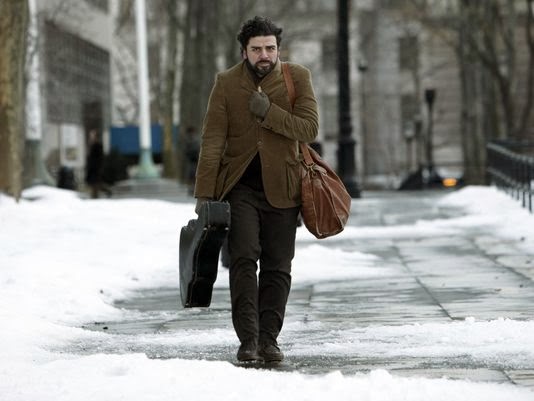
INSIDE LLEWYN DAVIS. FILM.

The Coen brothers schtick is getting a bit old at this stage.

Joel and Ethan Coen have been making films together for thirty years now, and have developed a very distinctive style.

In films like No Country for Old Men, Fargo, The Big Lebowski and O Brother Where Art Thou, they have made their idiosyncratic mark on Hollywood.

You can tell a Coen brothers' film almost immediately. There are many shots that frame the characters, making them appear small, and at the mercy of their environment. There are long, slow scenes, and characters that often remain impassive, usually in the face of things they don't understand.

Their films are atmospheric and obsessed with movie meta-references, they play games and always have a slightly unreal feeling to them.

And they love these eccentric, quirky characters who have a tenuous grip on their own sanity. Oh, and John Goodman, the rotund Goodman is in the majority of their films, and shows up here again as a heroin-addicted, misanthropic jazz musician.

Their central characters tend to be losers, people who live on the edge of society. They are generally misunderstood, dissatisfied, desperately trying to succeed or survive in a world that rejects them.

Llewyn Davis is another one of these. He is a folk singer in nineteen sixties New York, struggling to make an impact on the folk scene in that city. He is idealistic, refuses to compromise, and because of that is frequently penniless and reduced to sleeping on friends' couches.

And that's really it. We get the usual procession of quirky, off-beat characters that cross Llewyn's path as he attempts to get a break, there is a cat that is in the film for a while, and which then disappears, he falls out with people, makes up with them. We smile at their antics.

And yet there is no progression, no movement forward, Llewyn is more hopeless at the end than he was at the beginning. Things fall apart, and never get fixed.

The only transformative moments in the movie are when the protagonist plays music. Llewyn is transformed, from a defeatist, gloomy misanthropist into an artist, someone consumed by his music, able to produce beautiful sounds and be someone he cannot manage to be in the real world. These moments are the only times when the film transcends the Coen's usual quirk-fest, and touch something deeper and more profound.


Inside Llewyn Davis is an intermittently amusing portrait of a loser, who remains a loser. It has nice touches, as all Coen brothers films do, but is mostly insubstantial and irritating in its absolute refusal to allow any kind of growth or positive change to its central character.

Tuesday, 28 January 2014

TWELVE YEARS A SLAVE. FILM

Twelve years a slave, two hours of misery.

In fairness, if you go and see this film, you have been warned. The movie is exactly what it says in the title, an examination of the twelve years spent by free black man, Solomon Northrup, in slavery, after he was kidnapped from his home in New England in the 1850s and sold to traders in the South.

And so that is exactly what we get, a portrait of the violence, degradation and
brutality of the life of a slave. There is no let up for the length of the film, no respite from the misery. We see rapes, floggings, lynchings, torture, human beings being treated worse than animals, being treated like objects.

The evil and hatred of the white masters for their human property is pure and relentless, and the deprivations that they inflict on the slaves seem to have no end. Only Brad Pitt's character, an abolitionist originally from Canada but working in Georgia, shows the slightest bit of humanity when dealing with the black people there.

It is not an easy watch. The only aspect of the film that gives the viewer a break from the horror is the photography and camerawork, the shots of the southern countryside are composed like paintings, and look exotic and beautiful. It serves to contrast with the humiliation and violence that is the lot of the American slave.

Yet the misery is so relentless, it has to be wondered what the point is of this film. The message of the director seems to be that slavery is bad. But don't we know this already? If we have seen Roots, or even Django Unchained, from last year, surely we are aware that the life of a slave was no picnic.


For those people - if there are any out there - who still believe that slavery just wasn't that bad, that it was somehow a benevolent system where slaves' health was taken care of and their souls were saved, then certainly they need to see this movie. It is a true story and so gains more resonance from this fact. Yet beyond that, really only complete masochists (or sadists) need to see this brutal, stomach churning film. 

Saturday, 18 January 2014

THE WOLF OF WALL STREET. FILM.


The Wolf of Wall Street is the latest collaboration between Martin Scorcese and Leo Di Caprio. It is a lot of fun.

Di Caprio plays Jordan Belfort, who builds himself up from humble beginnings to a position as one of the most powerful men on Wall Street. He doesn't do it entirely legally, though, and soon comes under the spotlight of FBI agent, Patrick Denham.

Most of the movie is concerned with showing the decadent lifestyle of Belfort and his group of cronies that he accrues on his journey to the top.

We don't need either Belfort, who narrates, or Scorcese, who directs, to tell us how over the top, how obscene, the way of life of Wall Street traders was in the eighties and nineties.

There is no overt commentary on the amorality of the lifestyle, there doesn't need to be. We are simply shown the excess, the hookers, the mounds and mounds of drugs, the unending supply of cash and the bizarre, irresponsible behaviour, and allowed to make our own minds up.

The spirit of the times is captured perfectly, the "Greed is good" mantra of the bond traders of these unimaginable decades. We see the groupthink of the employees in the Stratton Oakmont offices, all united in their obsessive frenzy to get rich. Staff meetings are addressed by Belfort, and turn into a kind of Nuremberg rally, their leader in chief whipping his minions into a mania for selling and making cash.

Belfort's acolytes are the Keystone Cops, the biggest bunch of incompetent, drug addled, sex obsessed boors you can encounter in a Hollywood film. Despite this they make millions, through chutzpah, supreme confidence, greed and mountains of cocaine.

And it is a tremendous amount of fun. From the first frame it plays the situation for laughs. Jonah Hill, who plays Donny, Belfort's partner in crime, spends the whole movie with a set of comedy false teeth in. Donny, of course, is famed for being married to his cousin.

Jordan Belfort is basically a nineteen eighties/ nineties version of Leo Di Caprio's last role, as The Great Gatsby. He is a dreamer, like Gatsby, self-destructive, utterly self-absorbed, with a single-minded obsession to make piles and piles and piles of cash.

"Strattan Oakmont is America." This is Belfort's line in the middle of this movie, and it is not accidental. The name of the company is pulled out of the air by Belfort, it has no connection to him or anyone who works there, it is simply WASP-sounding enough to gain them the respect that they need to survive in the bond trading jungle.

It is the definition of self-invention. There is nothing real about either the profession, or Belfort's made up company, and yet precisely because of their lack of substance, they are a raging success.

The whole enterprise is built on sand. They start off by selling worthless penny stocks to Joe Schmos who don't know any better, and build up into insider trading and money laundering. It is the ugly side of American capitalism where anything goes as long as it makes money.

Like Goodfellas, there is a prominent voice-over, as Belfort narrates his rise and fall, with a certain wry cynicism. Di Caprio takes over the role, and gives us a real anti-hero. Belfort genuinely cares about the people around him, inasmuch as he is capable of doing, yet he constantly lets down his wives, partners and children in his mad obsession for making money, taking drugs and living life to the full.

The Wolf of Wall Street portrays a debauched, depraved period of recent American history. There is some affection here for its protagonists, they are shown as almost lovable oafish epicureans, devoted to enjoying life and getting rich. It is three hours long, but it moves at such a pace it feels like much less. It is relentless, energetic, frequently hilarious, and a boat load of fun. 

Saturday, 4 January 2014

AMERICAN HUSTLE. FILM

American Hustle will appeal to anyone who sees a film set in the 1970s as a kind of costume drama.


The hair is big and ridiculous, the lapels are wide, the chests are hairy and adorned with medallions. The film follows on from Mad Men in attempting to get all of the period details correct, the cars, the garish wallpaper, the disco, the dodgy fashions.

The film exploits that old American tale of grifters and con artists. Christian Bale plays Irving Rosenfeld, who has a number of scams on the go when he meets Sydney, (Amy Adams), who becomes both his business and romantic partner.

The pair get stung by Bradley Cooper's FBI agent and are forced to help him attempt to entrap public figures on corruption charges.

From there the story gets more complex, involving Irving's wife, played by Jennifer Lawrence, a local politician, senators, congressmen, a fake Arab Sheik, and Robert Di Niro as a mobster.

There is a touch of farce about the whole film, cartoon violence, Christian Bale's character gluing his toupee to his head, and Cooper's FBI agent with his hair in curlers. This sometimes pays off, and produces moments of humour, but overall it is an illustration that the film doesn't really know what it is.

There are comic elements, there is tension, a hint of danger with the mobsters, a sort of a love story between Irving and Sydney, and an attempt at a more serious examination of politics and the law.

Yet it is too disjointed, the movie doesn't seem to know where it's going most of the time. We have minor crises, small climaxes, and then the pace slows again. There is no real direction, no great building towards a denouement, the story kind of meanders.

This is not to say that there are not things to enjoy. Christian Bale is consistent in his portrayal of the central character, a slightly ineffective conman with a hangdog look and bad hair. Bradley Cooper is manic and driven as the FBI agent who is just after a bit of respect and success. There are some good jokes, and funny moments, including one with the first make of microwave to come out in the nineteen seventies.  

And Jennifer Lawrence - continuing the theme of pretty much every film she
has been in - takes over the screen when she is on it, playing Irving's feckless, manipulative, tipsy wife. Although she is again playing a role that is much older than her, she dominates the action even in the small part that she plays. 


American Hustle is likeable and gently humorous, but is lacking an edge. Worth a look for the great cast, but an opportunity lost.

Tuesday, 17 December 2013

WINTER FILMS: PRISONERS, BLUE JASMINE, HUNGER GAMES, DRINKING BUDDIES.

PRISONERS  is not for the faint hearted. Hugh Jackman (Wolverine) plays a man whose eight year old daughter, along with her friend, is kidnapped. The chief suspect, a man whose has a mental age of 10, is arrested and then released. Jackman's character goes to extreme lengths to track the guy down and attempt to find his kid.


The film maintains the tension expertly, inching the story along, teasing the viewer with clues and hints and suggestions, though the ultimate solution to the mystery is more or less signposted fairly early, and is not in fact such a massive twist.

There are some interesting moral questions, about what is a valid course of action to protect your family, how far is too far, etc. The film is effective in exploring these ideas.

It is, though, unremittingly hard and brutal. There is some heavy violence, and a lot of pain and dread, and - naturally, considering we are talking about child abduction - there are no lighter moments to relieve the gloom. It's a film that has to be endured, and admired, rather than enjoyed.

BLUE JASMINE is a Woody Allen film, though it is unlike the vast majority of his work. It is a tragedy, not a comedy. Though it retains a lot of the director's light touch, there is little to laugh at here.

The central character is Jasmine, played by Kate Blanchett. Her marriage to millionaire Alec Baldwin collapses when he is indicted on fraud charges and sent to prison for setting up a Ponzi scheme. She has a breakdown and goes to live with her foster sister, who she has only ever barely tolerated before her change in fortunes. Now she finds herself dependent on her.

The key problem with the film is that it is almost impossible to feel any sympathy for the central character. She is snobby, presumptuous, contemptuous of the people - working class San Franciscans - that her sister introduces her to.

In flashbacks we see that Jasmine is in fact partly to blame for her husband's downfall, and turned a blind eye to the strokes and dodgy dealings that she knew he was involved in. Jasmine does attempt to put her life together a little, before falling back into old patterns of lying and self-deception.

But it is hard to care about her, hard to root for her, hard to be moved by her successes and failures. And that is the failure of the film itself, it fails to create a complex enough protagonist that is anything more than the haughty cold-fish that she appears to be in the beginning.

Best film of the winter so far has to be THE HUNGER GAMES, CATCHING FIRE, the second in the series. The books that the films are based on are aimed at the teenage/young adult market, but the reason that the films work so well is the their themes and atmosphere are profoundly grown up.

The dystopia that acts as setting for The Hunger Games movies is a future United States that is divided into Sections and ruled by a dictatorship, Donald Sutherland again playing the dictator. The ruling classes use various forms of oppression to maintain order, including the annual Hunger Games, where teens from each of the Sections compete in a winner-takes-all battle to the death.

The games are entertainment for the masses, intended to distract them from the multitudes of limitations in their everyday lives. The losers are killed, the winners feted and gifted with unimaginable wealth and prestige.


Katniss Everdeen is the central character, another in a line of female protagonists in the sci-fi, fantasy genre, and is in truth probably the best and most complex of them all. She is brave, tough, principled, talented, contemptuous of the brutal status quo, willing to sacrifice herself for others.

In the second film, the past winners, including Katniss herself, are forced into competing in a grand Hunger Games, to discover the overall champion of the last twenty five years. It is the administration's attempt to quell a growing rebellion and threat to its rule.

These games, though, are different from the ones in the first film, partially because they now have Phillip Seymour Hoffman's character, Plutarch Heavensbee, running them. They are more brutal, and complex and dangerous than previous versions.

And there is more, too, a twist near the end that opens up the claustrophobia of the games and gives a new perspective on all of the action up until that moment. Throughout, the film is brooding, dark, threatening, though Woody Harrelson and Elizabeth Bishop, who play Haymitch Abernathy and Effie Trinket, do provide some light relief.

Yet it is this taut, suspenseful ambience that gives the movie its impact, and the performance of Jennifer Lawrence - who deservedly won an Oscar last year for Silver Linings - as Katniss, that holds the whole enterprise together.

Lawrence is mesmeric in the role, tortured and struggling and constantly attempting to control her disdain for the regime, and her fear for the ones she loves. Katniss is a reluctant heroine, but a heroine nonetheless, and Jennifer Lawrence communicates all of her character's conflicts perfectly. She is also stunningly beautiful in this movie, impossible to look away from whenever she is on screen.

The Hunger Games works mainly as it contains themes and ideas that are much more grown up than you would expect from a film aimed at the adolescent masses.

DRINKING BUDDIES is a frustrating film. It is frustrating, primarily because almost no character at any time actually says what they really mean.

It is not that they lie, it is just that every truth about them is left unsaid, they talk and act in a certain way, and never face up to what is really going on.


The film focuses on a number of employees of a small brewing company. Kate (Olivia Wilde, from House, among other things) is seeing Dave, but obviously has a thing for co-worker, Luke (Jake Johnson, playing practically the same role as his character, Nick, in New Girl). Luke, in turn, clearly likes Kate back, but is in a relationship with Jill (Anna Kendrick).


Things develop, but only a little, and not as much as they should. The film spends a lot of time promising action and events that it never delivers on. It has potential, and a certain subtle charm, but never becomes what it should.