Pages

Monday, 24 February 2014

HER. FILM.

In this film, Joaquin Phoenix's character falls in love with a character played by Scarlett Johannson. Not so unusual, you may imagine, except that Scarlett's character, Samantha, is a computer operating system that has been developed to be sentient.

HER is set in a near-future Los Angeles. It is a relatively benign vision of the future, everyone lives in these large, pristine apartments, there is no sign of
war or plague or disability, the few jobs that we encounter are all aided by technology or are involved with producing that tech.

The only scary thing is that, fashion-wise, the future is apparently inspired by Simon Cowell. The people generally dress as we do, except that - a prospect as terrifying in its own way as a zombie apocalypse - the men all wear high-waisted corduroy trousers, without a belt.

Technology is of course a central part of everyone's lives. We see citizens of this new Los Angeles walking around alone, but constantly talking, they are communicating with their home computers through a tiny device in their ear, listening to emails, having the news of the day read to them.

Theodore Twombly is Phoenix's character, a romantic who is going through a divorce from his childhood sweetheart. Phoenix plays his character as a kind of future version of Leonard from the Big Bang Theory, a sensitive, nerdy ingenue who just wants to be loved.

He thinks he has found what he is looking for in a new operating system for his computer, who calls herself Samantha. She has been designed to be sentient, and to be able to grow and evolve and actually feel emotions.

Theodore and Samantha quickly form a bond. He is lonely, she is curious about the world and willing to learn, despite her lack of a physical body. They even manage to have sex, of a sort.

The film's strength is that it doesn't denigrate Theodore and Samantha's relationship, it treats it as unusual but real. We are not invited to feel sorry for Theodore, or to look down on him, for not having a human girlfriend. They are in many ways like any other couple, they fall out, make up, profess their love for each other, argue about the future of their relationship.

The film's only weakness is that many, many scenes are simply Joaquin Phoenix talking to the disembodied voice of his computer through his communication device. The location may change but the conversations between Theodore and Samantha are the central part of the movie and so we spend a lot of time listening to her and looking at him. There is little action, and a lot of dialogues that look like monologues.


Still, this is a curious, hypnotic, charming film. It is a film that is sympathetic towards its characters, that likes them and invites you to like them too. It delves into situations that are actually now on the horizon, exploring what it is to be conscious and is interested in all the complications that technology causes, and will cause, in our lives. 

Wednesday, 12 February 2014

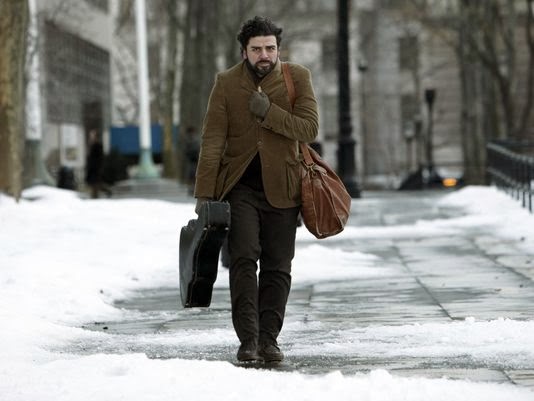
INSIDE LLEWYN DAVIS. FILM.

The Coen brothers schtick is getting a bit old at this stage.

Joel and Ethan Coen have been making films together for thirty years now, and have developed a very distinctive style.

In films like No Country for Old Men, Fargo, The Big Lebowski and O Brother Where Art Thou, they have made their idiosyncratic mark on Hollywood.

You can tell a Coen brothers' film almost immediately. There are many shots that frame the characters, making them appear small, and at the mercy of their environment. There are long, slow scenes, and characters that often remain impassive, usually in the face of things they don't understand.

Their films are atmospheric and obsessed with movie meta-references, they play games and always have a slightly unreal feeling to them.

And they love these eccentric, quirky characters who have a tenuous grip on their own sanity. Oh, and John Goodman, the rotund Goodman is in the majority of their films, and shows up here again as a heroin-addicted, misanthropic jazz musician.

Their central characters tend to be losers, people who live on the edge of society. They are generally misunderstood, dissatisfied, desperately trying to succeed or survive in a world that rejects them.

Llewyn Davis is another one of these. He is a folk singer in nineteen sixties New York, struggling to make an impact on the folk scene in that city. He is idealistic, refuses to compromise, and because of that is frequently penniless and reduced to sleeping on friends' couches.

And that's really it. We get the usual procession of quirky, off-beat characters that cross Llewyn's path as he attempts to get a break, there is a cat that is in the film for a while, and which then disappears, he falls out with people, makes up with them. We smile at their antics.

And yet there is no progression, no movement forward, Llewyn is more hopeless at the end than he was at the beginning. Things fall apart, and never get fixed.

The only transformative moments in the movie are when the protagonist plays music. Llewyn is transformed, from a defeatist, gloomy misanthropist into an artist, someone consumed by his music, able to produce beautiful sounds and be someone he cannot manage to be in the real world. These moments are the only times when the film transcends the Coen's usual quirk-fest, and touch something deeper and more profound.


Inside Llewyn Davis is an intermittently amusing portrait of a loser, who remains a loser. It has nice touches, as all Coen brothers films do, but is mostly insubstantial and irritating in its absolute refusal to allow any kind of growth or positive change to its central character.

Tuesday, 28 January 2014

TWELVE YEARS A SLAVE. FILM

Twelve years a slave, two hours of misery.

In fairness, if you go and see this film, you have been warned. The movie is exactly what it says in the title, an examination of the twelve years spent by free black man, Solomon Northrup, in slavery, after he was kidnapped from his home in New England in the 1850s and sold to traders in the South.

And so that is exactly what we get, a portrait of the violence, degradation and
brutality of the life of a slave. There is no let up for the length of the film, no respite from the misery. We see rapes, floggings, lynchings, torture, human beings being treated worse than animals, being treated like objects.

The evil and hatred of the white masters for their human property is pure and relentless, and the deprivations that they inflict on the slaves seem to have no end. Only Brad Pitt's character, an abolitionist originally from Canada but working in Georgia, shows the slightest bit of humanity when dealing with the black people there.

It is not an easy watch. The only aspect of the film that gives the viewer a break from the horror is the photography and camerawork, the shots of the southern countryside are composed like paintings, and look exotic and beautiful. It serves to contrast with the humiliation and violence that is the lot of the American slave.

Yet the misery is so relentless, it has to be wondered what the point is of this film. The message of the director seems to be that slavery is bad. But don't we know this already? If we have seen Roots, or even Django Unchained, from last year, surely we are aware that the life of a slave was no picnic.


For those people - if there are any out there - who still believe that slavery just wasn't that bad, that it was somehow a benevolent system where slaves' health was taken care of and their souls were saved, then certainly they need to see this movie. It is a true story and so gains more resonance from this fact. Yet beyond that, really only complete masochists (or sadists) need to see this brutal, stomach churning film. 

Saturday, 18 January 2014

THE WOLF OF WALL STREET. FILM.


The Wolf of Wall Street is the latest collaboration between Martin Scorcese and Leo Di Caprio. It is a lot of fun.

Di Caprio plays Jordan Belfort, who builds himself up from humble beginnings to a position as one of the most powerful men on Wall Street. He doesn't do it entirely legally, though, and soon comes under the spotlight of FBI agent, Patrick Denham.

Most of the movie is concerned with showing the decadent lifestyle of Belfort and his group of cronies that he accrues on his journey to the top.

We don't need either Belfort, who narrates, or Scorcese, who directs, to tell us how over the top, how obscene, the way of life of Wall Street traders was in the eighties and nineties.

There is no overt commentary on the amorality of the lifestyle, there doesn't need to be. We are simply shown the excess, the hookers, the mounds and mounds of drugs, the unending supply of cash and the bizarre, irresponsible behaviour, and allowed to make our own minds up.

The spirit of the times is captured perfectly, the "Greed is good" mantra of the bond traders of these unimaginable decades. We see the groupthink of the employees in the Stratton Oakmont offices, all united in their obsessive frenzy to get rich. Staff meetings are addressed by Belfort, and turn into a kind of Nuremberg rally, their leader in chief whipping his minions into a mania for selling and making cash.

Belfort's acolytes are the Keystone Cops, the biggest bunch of incompetent, drug addled, sex obsessed boors you can encounter in a Hollywood film. Despite this they make millions, through chutzpah, supreme confidence, greed and mountains of cocaine.

And it is a tremendous amount of fun. From the first frame it plays the situation for laughs. Jonah Hill, who plays Donny, Belfort's partner in crime, spends the whole movie with a set of comedy false teeth in. Donny, of course, is famed for being married to his cousin.

Jordan Belfort is basically a nineteen eighties/ nineties version of Leo Di Caprio's last role, as The Great Gatsby. He is a dreamer, like Gatsby, self-destructive, utterly self-absorbed, with a single-minded obsession to make piles and piles and piles of cash.

"Strattan Oakmont is America." This is Belfort's line in the middle of this movie, and it is not accidental. The name of the company is pulled out of the air by Belfort, it has no connection to him or anyone who works there, it is simply WASP-sounding enough to gain them the respect that they need to survive in the bond trading jungle.

It is the definition of self-invention. There is nothing real about either the profession, or Belfort's made up company, and yet precisely because of their lack of substance, they are a raging success.

The whole enterprise is built on sand. They start off by selling worthless penny stocks to Joe Schmos who don't know any better, and build up into insider trading and money laundering. It is the ugly side of American capitalism where anything goes as long as it makes money.

Like Goodfellas, there is a prominent voice-over, as Belfort narrates his rise and fall, with a certain wry cynicism. Di Caprio takes over the role, and gives us a real anti-hero. Belfort genuinely cares about the people around him, inasmuch as he is capable of doing, yet he constantly lets down his wives, partners and children in his mad obsession for making money, taking drugs and living life to the full.

The Wolf of Wall Street portrays a debauched, depraved period of recent American history. There is some affection here for its protagonists, they are shown as almost lovable oafish epicureans, devoted to enjoying life and getting rich. It is three hours long, but it moves at such a pace it feels like much less. It is relentless, energetic, frequently hilarious, and a boat load of fun. 

Saturday, 4 January 2014

AMERICAN HUSTLE. FILM

American Hustle will appeal to anyone who sees a film set in the 1970s as a kind of costume drama.


The hair is big and ridiculous, the lapels are wide, the chests are hairy and adorned with medallions. The film follows on from Mad Men in attempting to get all of the period details correct, the cars, the garish wallpaper, the disco, the dodgy fashions.

The film exploits that old American tale of grifters and con artists. Christian Bale plays Irving Rosenfeld, who has a number of scams on the go when he meets Sydney, (Amy Adams), who becomes both his business and romantic partner.

The pair get stung by Bradley Cooper's FBI agent and are forced to help him attempt to entrap public figures on corruption charges.

From there the story gets more complex, involving Irving's wife, played by Jennifer Lawrence, a local politician, senators, congressmen, a fake Arab Sheik, and Robert Di Niro as a mobster.

There is a touch of farce about the whole film, cartoon violence, Christian Bale's character gluing his toupee to his head, and Cooper's FBI agent with his hair in curlers. This sometimes pays off, and produces moments of humour, but overall it is an illustration that the film doesn't really know what it is.

There are comic elements, there is tension, a hint of danger with the mobsters, a sort of a love story between Irving and Sydney, and an attempt at a more serious examination of politics and the law.

Yet it is too disjointed, the movie doesn't seem to know where it's going most of the time. We have minor crises, small climaxes, and then the pace slows again. There is no real direction, no great building towards a denouement, the story kind of meanders.

This is not to say that there are not things to enjoy. Christian Bale is consistent in his portrayal of the central character, a slightly ineffective conman with a hangdog look and bad hair. Bradley Cooper is manic and driven as the FBI agent who is just after a bit of respect and success. There are some good jokes, and funny moments, including one with the first make of microwave to come out in the nineteen seventies.  

And Jennifer Lawrence - continuing the theme of pretty much every film she
has been in - takes over the screen when she is on it, playing Irving's feckless, manipulative, tipsy wife. Although she is again playing a role that is much older than her, she dominates the action even in the small part that she plays. 


American Hustle is likeable and gently humorous, but is lacking an edge. Worth a look for the great cast, but an opportunity lost.

Tuesday, 17 December 2013

WINTER FILMS: PRISONERS, BLUE JASMINE, HUNGER GAMES, DRINKING BUDDIES.

PRISONERS  is not for the faint hearted. Hugh Jackman (Wolverine) plays a man whose eight year old daughter, along with her friend, is kidnapped. The chief suspect, a man whose has a mental age of 10, is arrested and then released. Jackman's character goes to extreme lengths to track the guy down and attempt to find his kid.


The film maintains the tension expertly, inching the story along, teasing the viewer with clues and hints and suggestions, though the ultimate solution to the mystery is more or less signposted fairly early, and is not in fact such a massive twist.

There are some interesting moral questions, about what is a valid course of action to protect your family, how far is too far, etc. The film is effective in exploring these ideas.

It is, though, unremittingly hard and brutal. There is some heavy violence, and a lot of pain and dread, and - naturally, considering we are talking about child abduction - there are no lighter moments to relieve the gloom. It's a film that has to be endured, and admired, rather than enjoyed.

BLUE JASMINE is a Woody Allen film, though it is unlike the vast majority of his work. It is a tragedy, not a comedy. Though it retains a lot of the director's light touch, there is little to laugh at here.

The central character is Jasmine, played by Kate Blanchett. Her marriage to millionaire Alec Baldwin collapses when he is indicted on fraud charges and sent to prison for setting up a Ponzi scheme. She has a breakdown and goes to live with her foster sister, who she has only ever barely tolerated before her change in fortunes. Now she finds herself dependent on her.

The key problem with the film is that it is almost impossible to feel any sympathy for the central character. She is snobby, presumptuous, contemptuous of the people - working class San Franciscans - that her sister introduces her to.

In flashbacks we see that Jasmine is in fact partly to blame for her husband's downfall, and turned a blind eye to the strokes and dodgy dealings that she knew he was involved in. Jasmine does attempt to put her life together a little, before falling back into old patterns of lying and self-deception.

But it is hard to care about her, hard to root for her, hard to be moved by her successes and failures. And that is the failure of the film itself, it fails to create a complex enough protagonist that is anything more than the haughty cold-fish that she appears to be in the beginning.

Best film of the winter so far has to be THE HUNGER GAMES, CATCHING FIRE, the second in the series. The books that the films are based on are aimed at the teenage/young adult market, but the reason that the films work so well is the their themes and atmosphere are profoundly grown up.

The dystopia that acts as setting for The Hunger Games movies is a future United States that is divided into Sections and ruled by a dictatorship, Donald Sutherland again playing the dictator. The ruling classes use various forms of oppression to maintain order, including the annual Hunger Games, where teens from each of the Sections compete in a winner-takes-all battle to the death.

The games are entertainment for the masses, intended to distract them from the multitudes of limitations in their everyday lives. The losers are killed, the winners feted and gifted with unimaginable wealth and prestige.


Katniss Everdeen is the central character, another in a line of female protagonists in the sci-fi, fantasy genre, and is in truth probably the best and most complex of them all. She is brave, tough, principled, talented, contemptuous of the brutal status quo, willing to sacrifice herself for others.

In the second film, the past winners, including Katniss herself, are forced into competing in a grand Hunger Games, to discover the overall champion of the last twenty five years. It is the administration's attempt to quell a growing rebellion and threat to its rule.

These games, though, are different from the ones in the first film, partially because they now have Phillip Seymour Hoffman's character, Plutarch Heavensbee, running them. They are more brutal, and complex and dangerous than previous versions.

And there is more, too, a twist near the end that opens up the claustrophobia of the games and gives a new perspective on all of the action up until that moment. Throughout, the film is brooding, dark, threatening, though Woody Harrelson and Elizabeth Bishop, who play Haymitch Abernathy and Effie Trinket, do provide some light relief.

Yet it is this taut, suspenseful ambience that gives the movie its impact, and the performance of Jennifer Lawrence - who deservedly won an Oscar last year for Silver Linings - as Katniss, that holds the whole enterprise together.

Lawrence is mesmeric in the role, tortured and struggling and constantly attempting to control her disdain for the regime, and her fear for the ones she loves. Katniss is a reluctant heroine, but a heroine nonetheless, and Jennifer Lawrence communicates all of her character's conflicts perfectly. She is also stunningly beautiful in this movie, impossible to look away from whenever she is on screen.

The Hunger Games works mainly as it contains themes and ideas that are much more grown up than you would expect from a film aimed at the adolescent masses.

DRINKING BUDDIES is a frustrating film. It is frustrating, primarily because almost no character at any time actually says what they really mean.

It is not that they lie, it is just that every truth about them is left unsaid, they talk and act in a certain way, and never face up to what is really going on.


The film focuses on a number of employees of a small brewing company. Kate (Olivia Wilde, from House, among other things) is seeing Dave, but obviously has a thing for co-worker, Luke (Jake Johnson, playing practically the same role as his character, Nick, in New Girl). Luke, in turn, clearly likes Kate back, but is in a relationship with Jill (Anna Kendrick).


Things develop, but only a little, and not as much as they should. The film spends a lot of time promising action and events that it never delivers on. It has potential, and a certain subtle charm, but never becomes what it should.

Monday, 5 August 2013

JOHN BUTLER - THE TENDERLOIN. NOVEL.

The Tenderloin is the name of this novel, but it is also a seedy area of the city of San Francisco where the protagonist and narrator lives. The city itself is a character in the book, its hills, parks, trams and landmarks, as well as the resonant titles of some of the locations there - Nob Hill, Alcatraz, Haight, Fisherman's Wharf - are all an intrinsic part of the tale.

The central character, Evan, is a twenty-one year old Irishman who goes to San Francisco in 1995, just when it is on the cusp of the Internet revolution. He spends most of the first few months in penury until he gets a low level job in a technology TV station and his world opens up.

The novel is good on this, the burgeoning tech sector in California, the chancers, innovators, nerds, forward thinkers, and also the skeptics and Luddites, like Evan's friend, Milo, who don't believe that this Internet thing will ever catch on.

It is also good on the experience of being young and clueless and living in a foreign city. Evan is constantly tripping up, flailing around in his attempt to adapt to a place where potatoes are only a rare optional accompaniment to a meal and not the central part of it, where people really do sleep their way to the top, and where nerds camp overnight on the street in order to be in line to buy a new version of Windows.

Evan, as a central character, is a little annoying, however. He spends most of the novel messing up, taking his boss's car out  though he has never learned to drive, almost causing a boat he is on to crash, alienating friends, losing jobs. Towards the end he is a complete mess, alcoholic, utterly confused about his sexuality, not even very likeable.

And he never reaches any kind of resolution. He goes back home, just as confused as he was when he arrived.

The strength of The Tenderloin lies in the writing, which is zippy and funny and smart, full of pop culture references, wry observations and sharp dialogue. Girls are described as "Anistonian", in a slick reference to the Friends character. People talk in short, smart, pithy conversations, say things like "Boo ya," and "Feel me?", and the spirit of the times is constantly sketched out using markers like the OJ trial.

There are a number of weaknesses in the book though. It is frequently unclear, characters are introduced, not really described properly, and then briefly reappear again later when you have forgotten who they are. And even the title is never actually explained in the text of the book, a trip to Wikipedia is necessary to find out what relevance The Tenderloin has to the actual story. Unexplained, the title just hangs there as a needless mystery that is not very interesting when it is solved.

The biggest weakness though, is in the story and the central character. It is laid out like a coming of age story, though in fact Evan doesn't actually mature or grow at all. He doesn't seem to learn any important thing about himself in his time in San Francisco, and I found it difficult to even care about his development towards the end of the novel.


The Tenderloin is a vibrantly written, funny, smart book, that is let down a little by a weak protagonist and a narrative that doesn't really progress.